

Medically Reviewed by Dr. Brijen L. Joshi, MD | Vita Nova Ketamine & Wellness Clinic
Does Ketamine Actually Work for Chronic Pain?
For patients researching ketamine chronic pain Baltimore treatment options, the primary question is straightforward: does it work? The clinical answer is yes — for specific, hard-to-treat chronic pain conditions, intravenous (IV) ketamine infusion therapy has emerged as an effective treatment when administered in a controlled, physician-led setting. A 2023 meta-analysis published in Medicine Advances (Odutola et al.) confirmed that IV ketamine is both efficacious and safe for patients with chronic pain, demonstrating a statistically significant reduction in pain scores compared to controls across 16 randomized controlled trials involving 1,080 patients [1]. It is particularly effective for neuropathic pain conditions like Complex Regional Pain Syndrome (CRPS), fibromyalgia, and certain migraine disorders where traditional treatments, including opioids, have failed to provide lasting relief.
How Ketamine Works Differently Than Opioids
Unlike opioids, which primarily target the mu-opioid receptor system to temporarily block pain signals, ketamine works on a fundamentally different neurological pathway. This unique mechanism is why it can succeed where other medications have failed — and why it represents a clinically meaningful alternative for patients who have exhausted standard pain management options.
The NMDA Receptor Mechanism Explained Simply
In chronic pain, particularly neuropathic pain, the nervous system becomes hypersensitive — amplifying pain signals even with minimal stimulus. This phenomenon is called central sensitization. The primary driver of this process is a receptor in the spinal cord and brain called the N-methyl-D-aspartate (NMDA) receptor. When chronically over-activated by the neurotransmitter glutamate, the NMDA receptor keeps pain signals running at a persistently elevated level.
Ketamine acts as an NMDA receptor antagonist — it blocks glutamate from over-activating this receptor, interrupting the cycle of amplified pain signaling. A useful analogy: if chronic pain is like a car alarm that won’t shut off, opioids are like covering your ears to block the sound. Ketamine goes to the circuit breaker and turns the alarm off at the source. According to the National Institutes of Health, this glutamatergic mechanism is now a primary focus of next-generation pain research precisely because it addresses root-level nervous system dysfunction rather than downstream symptoms.
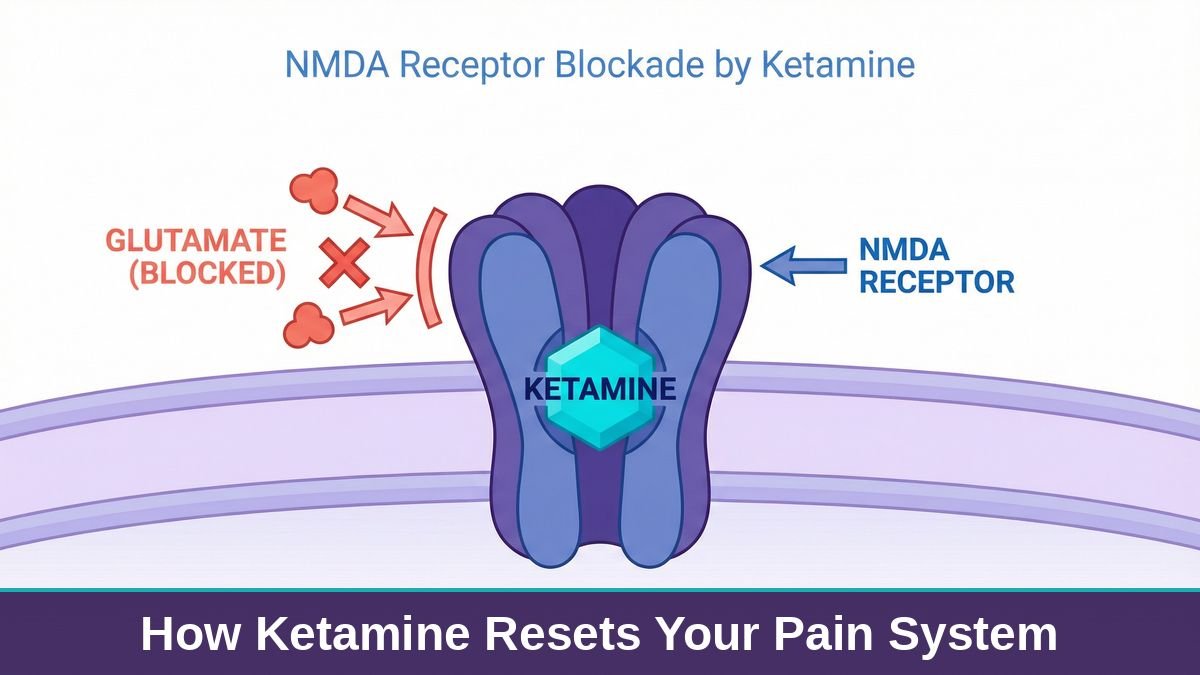
🧠 How Ketamine Breaks the Chronic Pain Cycle
By blocking NMDA receptors, ketamine does not simply mask pain — it interrupts the neurological feedback loop that maintains chronic pain. This can result in reduced central sensitization, promotion of new healthy neural pathways through neuroplasticity, and anti-inflammatory effects that outlast the drug’s presence in the body. This is why a short series of infusions can provide relief lasting weeks or months.
Why Ketamine Can Break the Chronic Pain Cycle
The downstream effects of NMDA receptor blockade include reduced central sensitization, promotion of neuroplasticity (the formation of new, healthy neural connections), and modulation of inflammatory pathways that contribute to chronic pain. These combined effects explain why a short series of ketamine infusions can produce pain relief that persists long after the drug has cleared the body — an outcome that is not possible with opioids, which require continuous dosing and lose effectiveness over time through tolerance.
Patients managing chronic pain alongside other wellness concerns may also benefit from complementary protocols. At Vita Nova, adjunctive nutrient support such as IV hydration therapy and NAD+ IV therapy may be incorporated into a broader care plan where clinically appropriate, supporting cellular energy and neurological function alongside ketamine treatment.
Chronic Pain Conditions Vita Nova Treats with Ketamine
At Vita Nova, under the guidance of Dr. Brijen L. Joshi, MD, the clinical team focuses on evidence-based applications of ketamine for the most challenging and treatment-resistant chronic pain conditions. Each patient is evaluated individually, and treatment is recommended only where the evidence and clinical picture support it.
Fibromyalgia
Fibromyalgia is a complex disorder characterized by widespread musculoskeletal pain, fatigue, cognitive difficulties, and sleep disturbances. It is estimated to affect 2 to 4 percent of the U.S. population, according to the Mayo Clinic. Standard treatments — including NSAIDs, antidepressants, and gabapentinoids — provide limited relief for many patients because fibromyalgia pain is not generated by peripheral tissue damage but by central nervous system amplification.
Because ketamine directly targets this central sensitization through NMDA receptor blockade, it addresses the root mechanism of fibromyalgia pain rather than downstream symptoms. The 2023 Odutola meta-analysis confirmed ketamine’s efficacy in reducing pain scores for fibromyalgia patients, and clinical experience at physician-led infusion centers supports its role as a meaningful option for patients who have not responded to standard care. Learn more about ketamine therapy for fibromyalgia at Vita Nova.
Complex Regional Pain Syndrome (CRPS)
Complex Regional Pain Syndrome (CRPS) is a severe, chronic neuropathic pain condition that typically affects a limb following injury, surgery, or stroke. It is characterized by disproportionate, burning pain, swelling, skin changes, and extreme sensitivity to touch. CRPS is notoriously difficult to treat, and many patients cycle through multiple specialists without finding lasting relief.
Ketamine has one of the strongest evidence bases for treating CRPS of any chronic pain condition. By blocking the profoundly overactive NMDA receptors that drive CRPS pain, a series of low-dose IV ketamine infusions can provide significant and sustained relief. According to the American Chronic Pain Association, CRPS patients often require specialized, multidisciplinary care — exactly the model Vita Nova provides. For patients dealing with related neuropathic or pelvic pain conditions, learn about ketamine for pelvic pain at Vita Nova.
Neuropathic Pain
Neuropathic pain results from damage or dysfunction of the nervous system itself, producing burning, shooting, stabbing, or electric-shock sensations. Common causes include diabetic peripheral neuropathy, post-herpetic neuralgia, chemotherapy-induced neuropathy, and nerve injury from surgery or trauma. Because neuropathic pain originates in the nervous system rather than peripheral tissue, it responds poorly to traditional analgesics including NSAIDs and opioids.
Ketamine’s ability to modulate NMDA receptor activity makes it a primary pharmacological candidate for refractory neuropathic pain. Clinical studies have shown meaningful pain reduction in patients with neuropathic conditions, and it is increasingly regarded by pain specialists — including those affiliated with Johns Hopkins Medicine — as a legitimate therapeutic option when first- and second-line treatments have been exhausted. Read more about ketamine for neuropathy treatment in Baltimore.
Migraine and Chronic Headache Disorders
For patients with intractable migraines or status migrainosus — a migraine lasting more than 72 hours — IV ketamine infusions have demonstrated promise as an acute, breakthrough treatment option. By interrupting pain signaling in the trigeminal nerve pathway and modulating central sensitization, ketamine can terminate a severe migraine attack when triptans, ergotamines, and other abortive medications have been ineffective. This is a specialized indication requiring careful clinical screening by Dr. Joshi. Learn more about ketamine migraine treatment in Baltimore.
Other Conditions Considered on a Case-by-Case Basis
Emerging evidence suggests that ketamine may be beneficial for additional pain conditions including certain types of cancer-related pain, phantom limb pain, and pain associated with hypermobility disorders such as Ehlers-Danlos Syndrome. The Vita Nova clinical team conducts a thorough evaluation to determine whether ketamine infusion therapy is safe, appropriate, and likely to benefit a patient’s specific condition before any treatment is initiated.
✅ Conditions with Strongest Clinical Evidence
While ketamine is studied across many pain conditions, the strongest and most consistent clinical evidence for significant, lasting relief is currently in Complex Regional Pain Syndrome (CRPS) and other forms of severe neuropathic pain. Fibromyalgia and refractory migraine also have a meaningful evidence base. All other conditions are evaluated individually.
What the Research Says: 2023 Meta-Analysis and Beyond
The use of ketamine for chronic pain is supported by a growing and increasingly robust body of peer-reviewed clinical research. The most recent comprehensive meta-analysis on this topic was published in Medicine Advances in 2023 by Odutola et al. — not in JAMA as originally anticipated, but in an equally peer-reviewed clinical journal. This distinction is noted for transparency.
Key Finding — Odutola et al., Medicine Advances, 2023 [1]: This meta-analysis synthesized data from 16 randomized controlled trials involving 1,080 patients and concluded that intravenous ketamine infusion is both efficacious and safe for chronic pain. It demonstrated a statistically significant reduction in pain scores compared to placebo or control medications. The incidence of side effects such as nausea or dissociation was not significantly different from controls in a clinical monitoring setting.
Supporting Reference — Michelet et al., Pain Physician, 2018 [2]: This earlier systematic review also found ketamine to be efficient in managing chronic non-cancer pain, particularly for neuropathic conditions, and is widely cited in clinical pain medicine literature. For a complete overview of how ketamine therapy is applied across chronic pain conditions at Vita Nova, see our Guide to Ketamine Therapy for Chronic Pain in Baltimore.

The Vita Nova Ketamine Protocol for Chronic Pain
Initial Consultation and Patient Evaluation
Your care at Vita Nova begins with a comprehensive consultation with Dr. Joshi or a member of the clinical team. This evaluation includes a review of your full medical history, prior diagnoses, current medications, previous treatments, and a detailed discussion of your pain — its character, location, duration, triggers, and functional impact. It is a thorough medical evaluation designed to determine whether ketamine is appropriate for your specific condition and to design a protocol tailored to your individual needs. Patients are encouraged to bring relevant records, imaging, and specialist reports to their first visit.
What a Ketamine Infusion Session Looks Like
- You will be comfortably situated in a private, calm treatment room at our 513 Bayview Blvd location.
- A small IV line is placed in your arm by a trained clinical professional.
- A carefully prepared ketamine solution in saline is infused at a slow, controlled rate over approximately 45 to 60 minutes.
- Throughout the infusion, you are continuously monitored — heart rate, blood pressure, and oxygen saturation are tracked with clinical-grade equipment.
- A medical professional remains with you or immediately available throughout the entire session.
- Many patients choose to listen to calming music or a guided meditation during the infusion.
Number of Sessions and Maintenance Planning
For chronic pain, a single infusion is rarely sufficient to produce lasting results. The standard initial protocol typically involves a series of 3 to 6 infusions over a 2 to 3 week period to achieve cumulative neurological benefit and reset sensitized pain pathways. Following the initial series, a personalized maintenance plan is developed based on your response to treatment. Maintenance or booster infusions are typically scheduled every 4 to 8 weeks to sustain pain relief over time. All protocol decisions are made by Dr. Joshi based on your clinical presentation — not a standardized schedule.
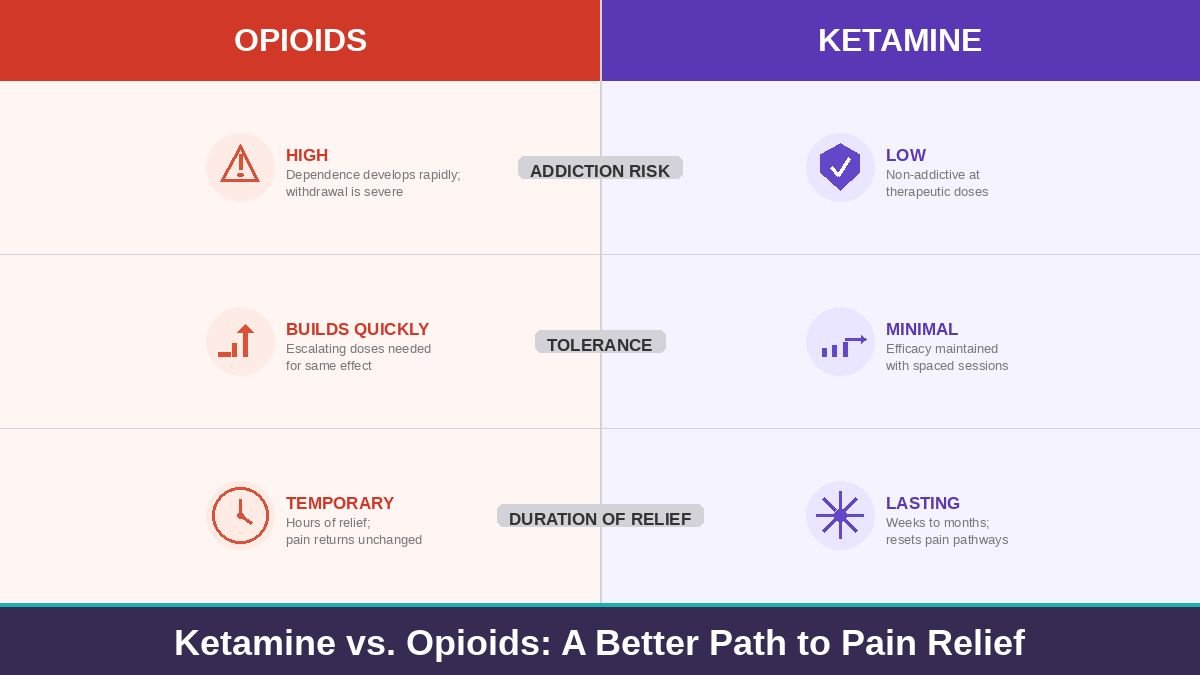
Ketamine vs. Opioids for Chronic Pain: A Direct Comparison
For patients considering their options, the following comparison addresses the most clinically relevant differences between IV ketamine and opioid therapy for chronic pain management. For a deeper clinical analysis, read our full post on ketamine vs. opioids for Baltimore pain patients.
| Feature | Ketamine (IV Infusion) | Opioids (e.g., Oxycodone, Morphine) |
|---|---|---|
| Mechanism of Action | NMDA receptor antagonist — targets central sensitization | Mu-opioid receptor agonist — temporarily blocks pain signal transmission |
| Addiction Potential | Low when used clinically at sub-anesthetic doses | High — significant risk of physical dependence and addiction |
| Effect on Central Sensitization | Reverses it — addresses the underlying mechanism | Can worsen it over time (opioid-induced hyperalgesia) |
| Side Effect Profile | Transient dissociation, elevated BP/HR during infusion — resolved on completion | Constipation, sedation, respiratory depression, hormonal effects |
| Long-Term Use | Effective with periodic maintenance infusions — no dose escalation required | Tolerance develops — requires dose escalation with diminishing returns |
| Applicability to Neuropathic Pain | Highly effective — targets the neurological source of pain | Generally poor efficacy for neuropathic pain conditions |
Is Ketamine for Chronic Pain Right for You?
Determining candidacy requires a full medical evaluation and is always a physician-guided decision. The following provides general guidance for patients exploring whether ketamine therapy may be appropriate.
You may be a good candidate if you:
- Have a confirmed diagnosis of a chronic pain condition such as CRPS, fibromyalgia, neuropathic pain, or refractory migraine.
- Have tried and not achieved adequate relief from standard treatments — including NSAIDs, anticonvulsants, antidepressants, opioids, physical therapy, or nerve blocks.
- Have no active psychosis, uncontrolled hypertension, or severe cardiac disease.
- Are seeking a non-opioid treatment that targets the neurological root of your pain rather than masking symptoms.
- Are able to arrange transportation, as you will not be able to drive yourself home after a session.
📋 Quick Candidate Reference
Likely Good Candidates: Patients with CRPS, fibromyalgia, neuropathic pain, or intractable migraines who have not responded adequately to standard treatments and have no significant cardiovascular or psychiatric contraindications.
Common Contraindications: Uncontrolled high blood pressure, severe cardiovascular disease, history of psychosis or current manic episode, active substance use disorder involving dissociatives. A full clinical evaluation by Dr. Joshi will assess all relevant factors individually.
Chronic Pain in Baltimore: Why Local Access to Ketamine Therapy Matters
Maryland has been significantly impacted by the opioid crisis, leaving many Baltimore residents managing chronic pain with limited effective options. For years, patients requiring specialized ketamine infusion therapy faced the burden of traveling out of state to access it. Having a physician-led clinic like Vita Nova in Canton, Baltimore, provides a critically needed local resource — one that operates under physician supervision rather than as an unmonitored wellness offering.
Patients who have exhausted options through major local institutions — including Johns Hopkins Pain Medicine, the University of Maryland Medical Center, and Baltimore area pain management practices — now have an accessible, evidence-based, physician-supervised alternative within the city. Safe, local access to ketamine chronic pain Baltimore treatment under the care of a physician represents a meaningful addition to the pain management landscape for our community. Patients from Baltimore City, Baltimore County, Anne Arundel County, and Howard County regularly seek care at Vita Nova’s 513 Bayview Blvd location in Canton. If you are also managing anxiety alongside chronic pain, our guide on ketamine for anxiety in Baltimore may also be relevant to your care.
Why Patients Choose Vita Nova for Ketamine Chronic Pain Treatment
Physician-Led Care from Day One
At Vita Nova, every patient is evaluated and treated under the direct supervision of Dr. Brijen L. Joshi, MD. This is a physician-led medical clinic — not a nurse-only practice or an IV wellness spa. Dr. Joshi’s clinical oversight ensures that every protocol is medically appropriate, that dosing reflects the patient’s individual health picture, and that safety is the primary consideration throughout the course of treatment.
Personalized Protocols, Not Standardized Treatment
Chronic pain is not a uniform condition. A patient with CRPS has different clinical needs than a patient with fibromyalgia or diabetic neuropathy. At Vita Nova, the treatment protocol is tailored to each patient’s diagnosis, medical history, and response to treatment. Patients who are also managing nutritional deficiencies may benefit from complementary services such as B12 shots Baltimore or the Vitality Circle membership, which provides ongoing access to IV nutrient therapy at $99.99 per month.
Comfortable, Private Treatment Environment
Our Canton clinic is designed with the chronic pain patient in mind. Private treatment rooms, comfortable recliners, soft lighting, and a calm environment support the therapeutic process and reduce the anxiety that many chronic pain patients carry into clinical settings.
Transparent Pricing and Documentation Support
Vita Nova provides clear, upfront pricing information for all ketamine infusion protocols. The clinic accepts HSA and FSA accounts. We also offer a dedicated insurance concierge service — our team checks your coverage, handles the documentation, and does the heavy lifting so you can focus on getting well. Use our insurance check form here →
Conveniently Located in Canton, Baltimore
Located at 513 Bayview Blvd in Canton, Vita Nova is accessible from all major Baltimore neighborhoods — including Fells Point, Harbor East, Federal Hill, and Hampden — as well as from Baltimore County, Anne Arundel County, and Howard County.
What to Expect Before, During, and After Your Infusion
Before Your Consultation
Gather your complete medical history including a list of all current medications, supplements, and prior treatments for your pain condition. Be prepared to describe your pain in specific clinical terms — its location, character (burning, stabbing, aching, electric), severity, triggers, and its impact on daily function. Bring any relevant imaging studies or prior specialist reports.
Before Your First Infusion
Do not eat for at least 4 to 6 hours before your infusion to minimize the risk of nausea. Clear liquids are generally permitted up to 2 hours before the session. Arrange a driver in advance — you will not be able to drive yourself home. Wear comfortable, loose-fitting clothing and leave valuables at home.
During the Infusion
Most patients experience a mild dissociative state during the infusion — a dreamlike quality where the external environment feels somewhat distant. This is expected at sub-anesthetic doses and resolves completely when the infusion ends. A member of the clinical team is with you or immediately available throughout the entire session.
After the Infusion
Some grogginess or mild disorientation may persist for 1 to 2 hours post-infusion, which is why transportation must be arranged. Most patients can return to normal activities the following day. Pain relief may be noticed immediately after the first infusion, or may build progressively across the treatment series.
❓ Frequently Asked Questions
How many ketamine infusions do I need for chronic pain?
Most chronic pain protocols at Vita Nova involve an initial series of 3 to 6 infusions over 2 to 3 weeks to achieve cumulative neurological benefit. The exact number depends on your specific condition and individual response to treatment. Following the initial series, maintenance infusions are typically scheduled every 4 to 8 weeks to sustain pain relief. All protocols are determined by Dr. Joshi based on your clinical presentation.
Is ketamine therapy for chronic pain covered by insurance in Maryland?
In most cases, health insurance plans in Maryland do not currently cover ketamine infusions for chronic pain, as it remains an off-label use. However, Vita Nova offers an insurance concierge service — we check your coverage for you, handle the heavy lifting, and let you focus on getting well. HSA and FSA accounts are also accepted. Submit your insurance information here and our team will take it from there.
How is ketamine different from opioids for pain management?
Ketamine works by blocking NMDA receptors to interrupt central sensitization — addressing the neurological mechanism that drives chronic pain. Opioids work by temporarily blocking pain signals at mu-opioid receptors without addressing the underlying cause, and over time can worsen pain sensitivity through opioid-induced hyperalgesia. Ketamine carries substantially lower addiction risk than opioids and does not produce the same tolerance or dose-escalation pattern.
What chronic pain conditions does Vita Nova treat with ketamine in Baltimore?
Vita Nova treats Complex Regional Pain Syndrome (CRPS), fibromyalgia, neuropathic pain from conditions such as diabetic neuropathy or post-herpetic neuralgia, and refractory migraines. Other conditions including phantom limb pain and certain cancer-related pain states are evaluated on a case-by-case basis. All treatment decisions follow a thorough physician-led evaluation.
Are ketamine infusions safe for long-term pain management?
When administered at sub-anesthetic doses in a controlled clinical environment with continuous monitoring, IV ketamine infusions are considered a safe approach to long-term pain management. The 2023 Odutola meta-analysis found that side effects were not significantly different from controls in clinical settings. At Vita Nova, all infusions are physician-supervised and patient safety is the primary consideration in every protocol decision.
How quickly does ketamine work for chronic pain?
Many patients report a noticeable reduction in pain during or immediately following their first infusion. For others, the therapeutic effect builds progressively across the initial treatment series. The goal is cumulative neurological benefit — resetting sensitized pain pathways rather than producing an immediate short-term effect.
Can I combine ketamine therapy with my current pain medications?
In many cases, yes. Dr. Joshi reviews all current medications during the initial consultation to assess for interactions and determine whether ketamine can be safely integrated with your existing treatment plan. For some patients, a successful course of ketamine therapy may reduce the need for other analgesic medications over time.
🔑 Key Takeaways
IV ketamine is a clinically supported treatment for specific chronic pain conditions, particularly neuropathic pain, CRPS, fibromyalgia, and refractory migraine.
Ketamine works by blocking NMDA receptors to interrupt central sensitization — the neurological mechanism that drives chronic pain — rather than masking symptoms.
Its mechanism is fundamentally different from opioids and does not carry the same risk of addiction, tolerance, or dose escalation.
A 2023 peer-reviewed meta-analysis (Odutola et al., Medicine Advances) confirmed that IV ketamine significantly reduces pain scores in chronic pain patients across 16 randomized controlled trials.
Standard treatment involves an initial series of 3 to 6 infusions over 2 to 3 weeks, followed by a personalized maintenance plan.
All ketamine therapy at Vita Nova is physician-supervised under Dr. Brijen L. Joshi, MD, and tailored to each patient’s individual clinical picture.
Vita Nova, located at 513 Bayview Blvd, Baltimore, MD 21224, provides physician-led ketamine chronic pain Baltimore treatment accessible to patients across Baltimore City, Baltimore County, Anne Arundel County, and Howard County.
Ready to Explore Ketamine for Chronic Pain in Baltimore?
If you are living with chronic pain and have not found adequate relief through standard treatments, IV ketamine therapy may be a clinically appropriate next step. We invite you to speak with Dr. Joshi and the Vita Nova clinical team to review your case and determine whether you are a candidate.
References
- Odutola O, et al. (2023). Efficacy and safety of intravenous ketamine for chronic pain: a systematic review and meta-analysis. Medicine Advances. onlinelibrary.wiley.com
- Michelet D, et al. (2018). A meta-analysis of the use of ketamine for adult chronic pain management. Pain Physician, 21(2), 159–173. PubMed
- National Institutes of Health. Chronic Pain: Symptoms, Diagnosis & Treatment. nimh.nih.gov
- Mayo Clinic. Fibromyalgia — Symptoms and Causes. mayoclinic.org
- American Chronic Pain Association (ACPA). Complex Regional Pain Syndrome. theacpa.org
- Johns Hopkins Medicine. Chronic Pain. hopkinsmedicine.org
Tags: Ketamine Therapy, Chronic Pain Baltimore, Ketamine for Pain, CRPS Baltimore, Fibromyalgia Treatment, Neuropathic Pain, Migraine Treatment Baltimore, Ketamine Infusion, Vita Nova, Dr. Brijen Joshi, Baltimore Ketamine Clinic, Pain Management Baltimore, NMDA Receptor, Opioid Alternative